Harbor Freight #63585 100 Watt Solar Kit
Seeking more power than what a 1.5 watt solar panel could provide, it's time to step up to the 100 watt solar kit, Harbor Freight item #63585. The manual, posted online as a PDF, fails to describe a few useful details which we'll cover here.
Every product picture showed the four panels lined up in a row. But in fact the four panels are capable of standing separately as each panel is in their own frame and has their own folding stand. Bolting them together is optional. If the panels are to be deployed and stowed frequently, leaving them separate might make sense as the panels are much easier to handle individually.
The package content lists wires but not their length. Each panel has a 3 meter long wire permanently attached. This wire terminates in a connector common to Harbor Freight solar products but its exact type specification is unknown. It is definitely not the MC4 connector common in rooftop solar installations.
(UPDATE: Thanks to a tip in the comments, we now know this is a connector commonly used in the automotive world and can be purchased from auto parts stores. For example it is commonly used to make electric connections to trailers. While this connector follows the pattern of SAE J928 and J1239, it is not explicitly covered by either specification.)
The four panels connect into a 4-to-1 module. The four wire side are half a meter long, and the unified side has a 3 meter long wire towards the controller. A final half-meter long adapter has the unknown HF solar automotive connector on one end and a barrel connector on the other. (~5.5mm OD, ~1.5mm ID, 12mm length) The barrel connector fits into a corresponding jack on the controller.
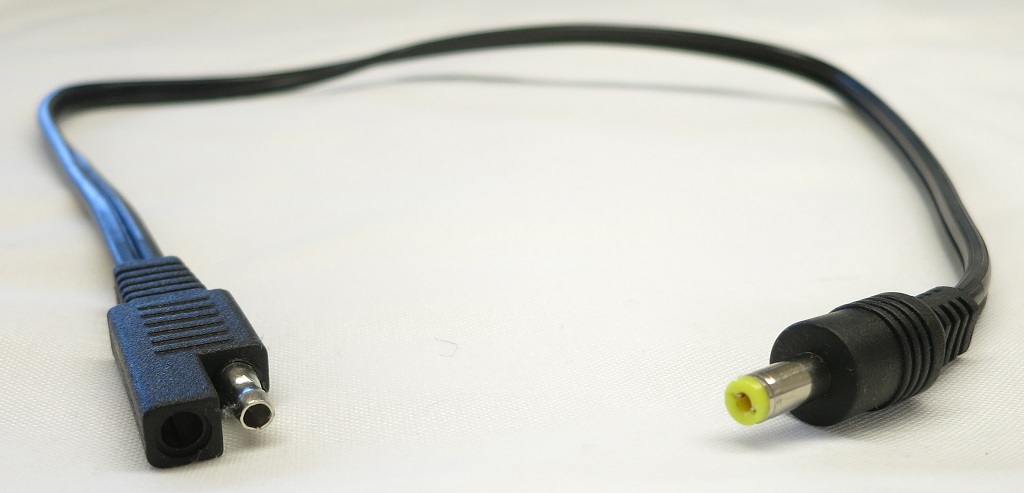
Adding it all up: Each of the panels can be up to 3.5 meters from the central 4-to-1 hub, and that hub can be up to 3.5 meters from the controller. The package includes a 1 meter cable to connect controller to battery.
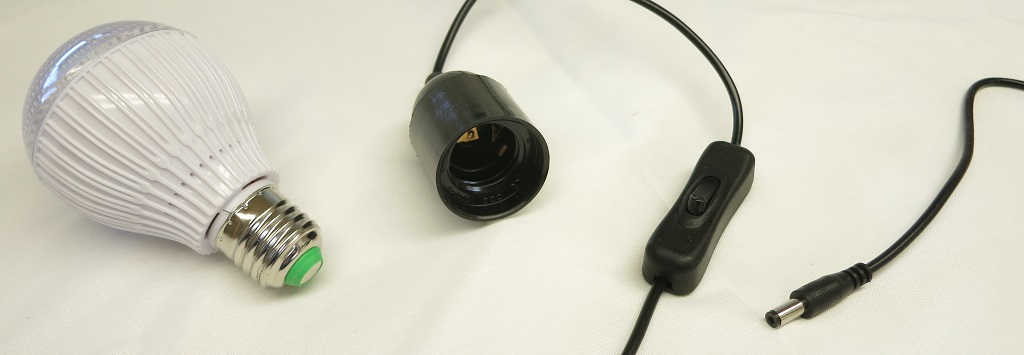
The kit included two LED light bulbs, each of which have a 5 meter long wire. Curiously, the long wire ends in a standard light bulb socket. But instead of the 120V AC household voltage we would expect from such a socket, it carries the battery DC voltage. This is a decidedly nonstandard and confusing way to do things. (UPDATE: An earlier version of this paragraph incorrectly stated 120V AC conversion took place, a bad assumption based on the standard light bulb socket. Voltage meter told the truth and paragraph has been rewritten.)
The simple charge controller covers the basics, guarding against battery overcharging and over-discharging at adjustable voltage thresholds. The manual claims there is over-current protection as well, but there appears to be no way to adjust the current limit, either for charging or for discharging.